Healing Out Loud: Breaking the Silence Together


I am really struggling right now. I’m in the middle of the legal process from my assault, and there are days I want to give up—not on life, but on my case. I so badly want my peaceful life back. Digging this all up after a year and knowing it most likely won’t be resolved in court for at least another year is beyond daunting. Every day feels like walking in quicksand, fighting to keep myself from being pulled under.

I chose early on to be open with my story with my loved ones and recently also with colleagues. I did not make that decision lightly, and I wish I could say I am always confident with it, but I am far from it. I constantly worry if people look at me differently—if they believe me, judge me, or judge my decision to share. Most days, I feel a bit like an animal in a zoo, on display for everyone to watch from afar but never get close enough to connect.

Then there are days like today that remind me why I am healing out loud. A young lady in my office reached out with her own story, seeking advice. I wish I could say this never happens, because it means another survivor, but unfortunately, it happens often.


When I first started sharing my story, it felt like stepping into an abyss. The fear, the shame, and the stigma surrounding sexual assault are powerful forces designed to keep survivors silent. But I chose to heal out loud, and here’s why.

Silence Breeds Isolation

One of the most insidious effects of sexual assault is the isolation it creates. The trauma can make you feel like you’re the only one, fostering a deep sense of loneliness. By speaking out, I aim to shatter that illusion. You’re not alone. We are many, and together, our voices form a chorus of strength and resilience.

Power in Vulnerability

Healing is a journey, not a destination. For me, part of that journey involves embracing vulnerability. Sharing my story is not just about recounting past events; it’s about reclaiming my power. It’s about standing tall and saying, “This happened to me, but it does not define me.” Every time I share, I take a step away from the shadows of my past and into the light of my future.

Creating a Safe Space

When I speak out, I hope to create a safe space for others to do the same. Society often tells us to keep quiet, to bury our pain. But when we share our stories, we challenge that narrative. We create a community where survivors can find solace, understanding, and support. We build a world where silence is no longer the norm, and healing is.

Raising Awareness

Every story shared is a beacon of awareness. It highlights the prevalence of sexual assault and the urgent need for change. By healing out loud, I hope to contribute to a culture that supports survivors, holds perpetrators accountable, and ultimately, works towards preventing sexual assault.

Empowering Others

Healing out loud is not just about my journey; it’s about empowering others to embark on their own. When survivors see someone like them speaking out, it can inspire them to find their voice. It can give them the courage to seek help, to share their story, and to start their own path to healing.

Breaking the Cycle

Silence perpetuates the cycle of abuse. By speaking out, we disrupt that cycle. We shine a light on the dark corners where abuse thrives. We educate others about the signs, the impact, and the importance of consent. Every voice raised against sexual assault is a step towards breaking the cycle and creating a safer world for future generations.

Healing out loud is not easy, but it is powerful. It is a declaration that we will not be silenced by our trauma. It is a commitment to ourselves and to others, that we will seek healing and help others do the same. Together, we can transform our pain into a powerful force for change. If my story helps just one person feel less alone, then every word has been worth it.

So, to all the survivors out there: I see you. I hear you. Your voice matters. Let’s heal together, out loud and unafraid.

In love and solidarity,

M
Understanding PTSD: The Impact on Sexual Assault Survivors

Today, I want to delve into a topic that is often misunderstood but profoundly affects many survivors of sexual assault: Post-Traumatic Stress Disorder (PTSD). PTSD is a complex condition that can have lasting effects on a survivor’s mental, emotional, and physical well-being. Prior to my assault I thought I had an understanding of what PTSD was. I was severely misinformed. To shed light on this important topic, I’ll draw insights from the book “The Body Keeps the Score” by Dr. Bessel van der Kolk, a renowned expert in trauma research.

For me, the nightmares began night one and lasted at least 6 months. The flashbacks, intrusive memories, and intense emotional reactions began immediately and lasted all day for months. I couldn’t do anything for more than a few minutes without an intrusive thought punching me in the gut and causing me to lose my breath for a moment. The smell of cigarettes anywhere near me sent me right back to that night and his smoky breath on me. Even if I was safe with friends or family, my body felt imminent danger as if I really was fighting for my life. The hypervigilence was also immediate. In case anyone isn’t familiar, hypervigilence is a state of heightened alertness, sensitivity and awareness to potential threats or dangers in the environment. It was as if my head was constantly on a swivel out in public. I couldn’t be in a restaurant because the constant scanning for danger, sudden movements of others, and the potential for the unknown was too overstimulating. If I did go out in public it exhausted me for days. None of this was a surprise to me. These were all PTSD symptoms I expected from watching war movies.

What caught me completely by surprise was the anger. I am not an angry person. In fact, I tend to be more of a pushover than a pushback type of person. Months into my healing journey I found myself without an ounce of patience for anyone or anything. I felt constantly on edge, annoyed, and ready to fight anyone that even looked in my direction. I found it nearly impossible to manage humans when part of my job is to listen to the needs of others. Their complaints and gripes felt minimal compared to the hurricane going on inside my body. The angrier I became the more I beat myself up for being angry. I became a life coach to help other people with their problems. What is wrong with me!? The anger I felt towards myself and others was eating me alive. I picked up the book, The Body Keeps the Score and it was one of the most validating feelings I had. And one of the first times I envisioned channeling that anger towards advocacy.

The Body Keeps the Score is a dense book full of medical jargon that doesn’t make for an easy read if you aren’t into that sort of thing. I have highlighted some of the most meaningful takeaways for me personally:

  1. The Nature of PTSD: Dr. van der Kolk describes PTSD as a response to overwhelming traumatic events, where the brain and body struggle to process and integrate the experience. For survivors of sexual assault, the trauma can manifest in intrusive memories, flashbacks, nightmares, and intense emotional reactions.
  2. Dysregulation of the Nervous System: One key concept highlighted in the book is the dysregulation of the nervous system in trauma survivors. Sexual assault can trigger a heightened state of arousal, known as hypervigilance, where survivors remain on high alert for potential threats. Conversely, some survivors may experience dissociation, a state of emotional detachment or numbness, as a coping mechanism to distance themselves from the trauma.
  3. Impact on Brain Structures: Dr. van der Kolk explores how trauma alters brain structures, particularly the amygdala, hippocampus, and prefrontal cortex. The amygdala, responsible for processing emotions, becomes hyperactive in response to perceived threats, leading to exaggerated fear responses. Meanwhile, the hippocampus, crucial for memory consolidation, may struggle to differentiate between past trauma and present safety, contributing to intrusive memories and flashbacks. The prefrontal cortex, involved in decision-making and impulse control, may also be impaired, affecting survivors’ ability to regulate emotions and engage in effective coping strategies.
  4. Somatic Symptoms: “The Body Keeps the Score” emphasizes the somatic manifestations of trauma, where survivors may experience physical symptoms such as chronic pain, gastrointestinal issues, and autoimmune disorders. These somatic complaints are often linked to the dysregulation of the autonomic nervous system, which governs involuntary bodily functions, including heart rate, digestion, and immune response. For survivors, these physical symptoms can further exacerbate their distress and impact their quality of life.
  5. The Role of Trauma Therapy: Despite the challenges posed by PTSD, Dr. van der Kolk offers hope through trauma-focused therapies such as Eye Movement Desensitization and Reprocessing (EMDR), cognitive-behavioral therapy (CBT), and somatic experiencing. These approaches aim to help survivors process and integrate their traumatic experiences, regulate their nervous system responses, and develop coping skills to manage distressing symptoms.

Anger specific takeaways:

  1. Anger as a Response to Trauma: Dr. van der Kolk emphasizes that trauma, particularly experiences of sexual assault, can evoke intense feelings of anger in survivors. This anger may stem from a sense of powerlessness, betrayal, or violation of boundaries during the traumatic event. Survivors may also harbor anger toward perpetrators, society’s failure to protect them, or even themselves for what happened.
  2. The Physiology of Anger: Understanding the physiological underpinnings of anger is crucial. Trauma triggers the body’s fight-or-flight response, flooding the system with stress hormones like adrenaline and cortisol. For survivors, this heightened state of arousal can lead to a persistent sense of irritability, agitation, and rage. Additionally, trauma may dysregulate the amygdala, the brain’s emotional center, amplifying emotional responses and making it difficult to modulate anger.
  3. Anger Turned Inward: Dr. van der Kolk highlights that many survivors internalize their anger, directing it inward toward themselves. This self-directed anger may manifest as self-blame, self-destructive behaviors, or feelings of worthlessness and shame. Survivors may struggle with accepting themselves or forgiving perceived mistakes, leading to profound emotional turmoil and self-sabotage.
  4. Healing Through Anger: While anger can be overwhelming and disruptive, it also serves as a potent catalyst for healing. Dr. van der Kolk advocates for the acknowledgment and expression of anger as a vital step in the trauma recovery process. Through therapy and support groups, survivors can safely explore and process their anger, reclaiming a sense of agency and empowerment in the aftermath of trauma.
  5. Transforming Anger into Advocacy: Beyond individual healing, survivors’ anger can fuel collective action and social change. Many survivors channel their anger into advocacy efforts, speaking out against sexual violence, advocating for policy reforms, and supporting fellow survivors. By transforming their anger into a force for justice and empowerment, survivors reclaim their voices and contribute to a culture of resilience and accountability.

Reading this book didn’t magically heal any of my PTSD symptoms but it did give me a sense of control back knowing that everything I was feeling was normal and as the different stages of healing came, I was prepared with what was to come.

Understanding the impact of PTSD on sexual assault survivors is crucial for providing effective support and interventions. By recognizing the interconnectedness of trauma, the brain, and the body, we can empower survivors on their journey toward healing and recovery.

If you or someone you know is struggling with PTSD or the aftermath of sexual assault, I encourage reaching out to qualified mental health professionals for support and guidance.

With love and solidarity,

M

Embracing the Nonlinear Journey

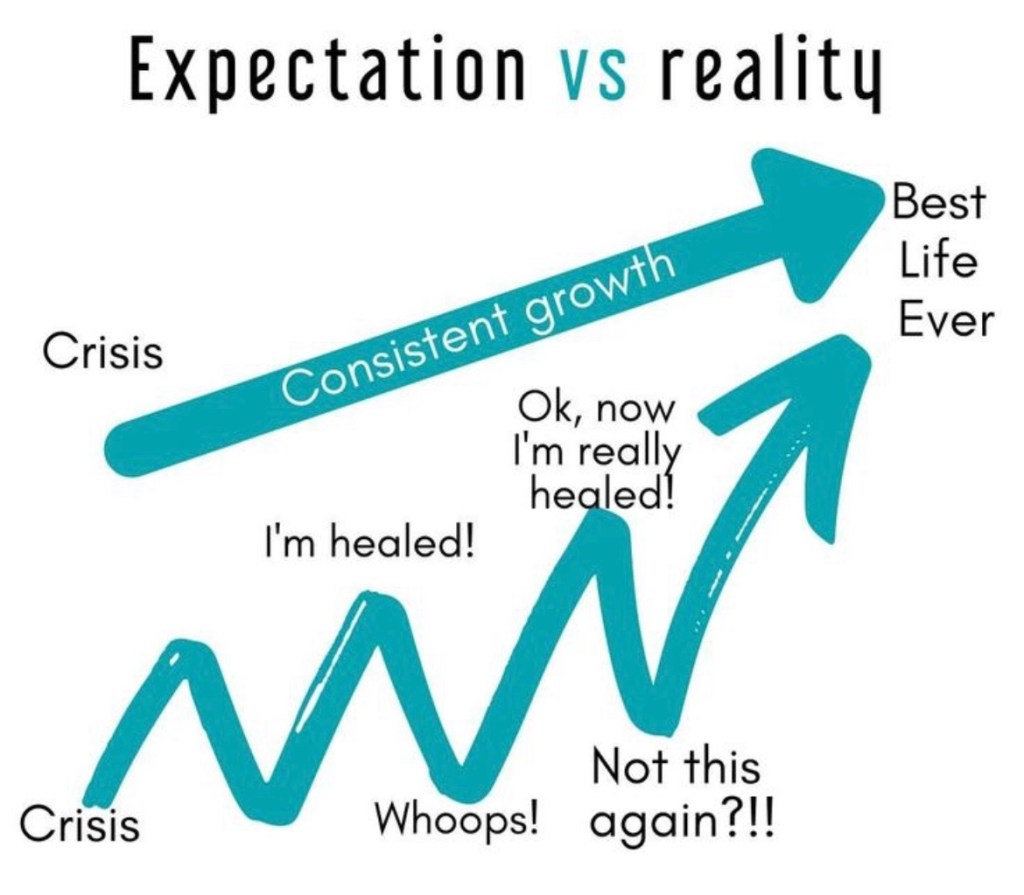
As we navigate the tumultuous waters of healing from any trauma, it’s crucial to understand that the path to recovery is not a straight line. It’s not a neat, linear progression from trauma to triumph. Instead, it’s a complex, often messy journey with ups and downs, twists and turns. In this blog post, we’ll explore why healing from trauma is not linear and how embracing the nonlinear nature of our journey can be empowering and liberating.


The Myth of Linear Healing:

Society often perpetuates the myth that healing from trauma, including sexual assault, follows a linear trajectory. We’re told to “move on” or “get over it,” as if healing were a checklist to be completed within a certain timeframe. However, the reality is far more nuanced. Healing is a deeply personal and individual process, and it unfolds differently for each survivor.

Let me get personal with this-

My assault happened in July of 2023. It’s been almost 7 months. Some days feel like it was years ago and other days feel like it was yesterday. You know that feeling of losing a loved one and you wake up and for a few moments before you are fully conscious, life is good? The first few weeks after my assault, I didn’t have that. The day after, I remember waking up and feeling like I had been crying in my sleep. Maybe I never fully slept or maybe I went so quickly from the subconscious to the conscious that those precious blissfully unaware seconds had no time to be felt. Either way that first day feeling bled into every day that first two weeks. There was no relief. I drifted in and out of sadness, anger, shock, terror, and panic. I stayed with friends 30 miles outside of town, too scared to go back to my own home. The assault occurred in my home so it no longer felt like a safe space.

I remember talking to coworkers online, or friends in person or on the phone and being so jealous that anyone could talk about anything else. Traumatic events like this might stop our world but it doesn’t stop the world around us from happening. It was such a complex and confusing feeling to feel grateful for the topic change that I knew was a distraction attempt via loved ones but there was absolutely no distraction that could pull me out of the mess in my head and my body. I felt physically ill that entire first week. The lack of nutrition, sleep and overall stress wreaked havoc on my body and my mind. 

Every time I think I am on the other side of this, I am jolted back onto the roller coaster that I never asked to be on. I’ve gone for weeks and most recently, months without a tear, any significant burst of anger or shame dragging me down but today knocked me on my ass. I have heard nothing about my case since before Christmas. I have been able to live in lala land a little bit since then, putting my case and this awful man to the back of my mind as much as possible.

Today, I was going about my morning getting ready for the work day to start when I got a call with an update from the detective assigned to my case. It never matters if the content of the update is significant or particularly upsetting. The content never matters- it’s the jolt back to July 30th and a brutal reminder that this really did happen. It took me from just another normal day where I feel like myself to those first few weeks where I feel like I am suffocating again and I struggle with the fact that the world continues on as if I am not drowning. It hasn’t just magically gone away and there is still so much agony that I will have to face before this is finally “over”. And is it ever really over? I don’t know yet. I just know it still hurts. I’m still angry. There is still shame, but it’s all under the surface and it comes back up in moments I don’t expect.  I am still unbelievably disgusted that people like this exist and are walking around like normal humans among us. These days make me want to throw in the towel legally. I want to quit all of it, run away and live my life as if this never happened.

In the past I would have let this “regressive” state make me feel like I am weak or haven’t healed enough. This triggered state could easily send me (and has) down a dark tunnel that I cannot get out of for days. Once I learned more about how the path of healing actually works I began to give myself more grace.

Healing from any trauma is nonlinear for several reasons:

  1. Triggers and Flashbacks: Survivors may experience triggers or flashbacks that evoke intense emotions and memories associated with the trauma. These triggers can occur unexpectedly, disrupting the healing process and causing setbacks.
  2. Healing Isn’t Linear: The journey of healing is filled with peaks and valleys, progress and setbacks. One day, you may feel empowered and hopeful, while the next, you may struggle with overwhelming emotions or symptoms of PTSD. This ebb and flow is natural and doesn’t diminish your progress or strength.
  3. Healing is Cyclical: Just as the seasons change and cycles repeat, healing from sexual assault often follows a cyclical pattern. You may revisit certain emotions or memories multiple times, each time gaining new insights and perspectives.
  4. Growth and Regression: Healing involves periods of growth and regression. You may make significant strides forward, only to encounter challenges that prompt a temporary regression. This doesn’t mean you’ve failed; it’s simply a natural part of the healing process.
  5. Self-Discovery: Healing from sexual assault is not just about overcoming trauma; it’s also a journey of self-discovery and self-compassion. Along the way, you may uncover layers of yourself, confront deeply ingrained beliefs, and redefine your identity in empowering ways.

I won’t lie and say that I am not still taken aback by these waves. They still take my breath away and completely stop me in my tracks. I have to actively acknowledge what is happening and do my best to move through it. I cry, I write, a call a trusted friend, I move my body, and I remind myself how far I have come.

Instead of viewing the nonlinear nature of healing as a sign of weakness or failure, we can embrace it as a source of strength and resilience. Embracing the nonlinear journey means:

  1. Practicing Self-Compassion: Be gentle with yourself on the difficult days. Acknowledge your progress, no matter how small, and offer yourself kindness and understanding.
  2. Seeking Support: Surround yourself with a supportive network of friends, family, therapists, and fellow survivors who understand the complexities of healing.
  3. Honoring Your Needs: Listen to your body and mind, and honor your needs in each moment. Whether it’s taking a break, practicing self-care, or seeking professional help, prioritize your well-being.
  4. Celebrating Victories: Celebrate your victories, no matter how small. Whether it’s setting boundaries, speaking your truth, or reclaiming your joy, every step forward is worth celebrating.

I do not wish trauma of any kind on anyone, but as cliche as it sounds, we cannot have rainbows without rain. I try to view my trauma as an opportunity to grow into a stronger and more resilient woman. I have learned so much about myself, my intuition, and my ability to do things I never thought I could that I may not otherwise have ever fully realized. We don’t have a lot of control over others and the harm they cause us but there is something extraordinarily powerful in knowing the control we have over our reactions and who we become through those experiences.

Healing from trauma is a nonlinear journey, filled with twists and turns, ups and downs. It’s okay to not be okay, and it’s okay to embrace the messiness of your healing process. Remember, healing is not about reaching a destination; it’s about embracing the journey, embracing your strength, and embracing yourself.

With love and solidarity,

M